Spartan San Antonio Trifecta Weekend – Race Review (November 22, 2025)
- Dec 31
- 9 min read
Updated: Feb 7
Overview
This year, San Antonio marked a significant change on the Spartan calendar. In previous years, this event was solely a Super/Sprint, but this year they introduced a Beast, offering a Trifecta weekend as we conclude the race season in December. It's a great opportunity for those attempting to complete their first Trifecta weekend or squeeze in another Beast on a relatively flat course.

If ever a Spartan Race venue was aptly named, it's Sandy Oaks Ranch in Devine, Texas. I can't think of a sandier venue on the calendar other than Houston—though I haven’t raced in Abu Dhabi yet. Sandy Oaks had easy logistics, was close to hotels and food, and was flat and fast. I’ve been racing in Texas for over ten years now, including Spartan and other trail races, and this place fits that familiar pattern: deceptively simple terrain until the sand starts wearing on your ankles mile after mile.
Sandy Oaks is fascinating not only for its course but also for its land and history. South Texas, characterized by its ancient coastal plains and clear skies, boasts a human history that stretches back thousands of years, influenced by ancient geology and the most significant cosmic event in Earth's history.
The Ground Below

Whenever you run a race in Texas, you're treading on terrain molded by the most catastrophic day in Earth's history. Sixty-six million years ago, an asteroid the size of a city collided with the Yucatán, unleashing energy equivalent to a billion nuclear bombs, causing oceans to boil, darkening the sky, and transforming the planet in a single morning. Texas bears the remnants—tsunami deposits, shocked quartz, and limestone fractured and reformed in the aftermath. This brief exploration delves into how that impact reshaped the Gulf Coast, altered the Hill Country beneath your feet, and ultimately paved the way for mammals—and eventually us—to exist.
If you've ever been curious about the ancient disaster beneath your race course, here is more detail
The Sky Above

While I was in Texas I set up by portable Seestar S50 rig and shot M33 — the Triangulum Galaxy — the kind of deep-space engine that makes meteor impacts possible in the first place. Galaxies are giant star-factories, and star-factories are messy. They build suns, worlds, and nebulae, but they also leave behind debris: leftover rock, ice, metal, and dust that eventually becomes comets and asteroids. Every meteor that ever streaked across Earth’s sky — including the one that ended the age of dinosaurs — began as scrap material inside a galaxy just like M33.
So when I photographed M33 from Texas, I wasn’t just capturing a pretty spiral of stars; I was looking at the same kind of cosmic workshop that forged the raw ingredients of our own solar system. It felt fitting to shoot it from Texas, not far from the region shaped by the Chicxulub impact — a landscape literally written by the debris of galactic creation. M33 is a reminder that these distant swirls of light are not abstract or remote; they are where worlds and catastrophes are born. Here is the full field report on this data capture and more info on M33.
The Path Behind

Long before Devine, Texas was ranchland, highways, or race venues, this region was home to thousands of years of Indigenous history—Archaic hunter-foragers, Coahuiltecan-speaking bands, and the people who later entered (willingly or under pressure) the early Spanish mission system. The full story is far richer and far older than most Texans ever hear: mobile families tracking game across dry uplands, flint tools scattered along seasonal waterways, catastrophic population collapse after European contact, and entire cultural worlds absorbed into missions whose records only hint at what was lost.
This summary uncovers the deep human timeline beneath modern Devine—millennia of movement, adaptation, disappearance, and survival—revealing a landscape shaped as much by its earliest peoples as by anything built in the last two centuries. For more info on the history of the region click here.
Lo
The Path Thru - Race Venue - Sandy Oaks Ranch
Travel and Logistics

For this race, I flew into San Antonio International, a sizable and modern airport with rental cars just a short walk from the terminal. I anticipated significant travel issues due to the government shutdown, but when I left Charlotte on Friday and from San Antonio on Sunday, there were virtually no problems. I never check bags, and this was a race where there was no way I was going to hand over race gear considering the overriding travel circumstances. Travel light and reduce headaches.
In San Antonio, the rental car was just a short walk from the airport. I decided to stay in Jourdanton—about 45 minutes south of San Antonio Airport and 30 minutes east of the venue—due to limited options near the ranch. Anyone who has been to Texas knows that there is a lot of distance between towns, but Texans also understand that speed limits are well... generous. At 6 a.m., the roads are empty, the speed limit was 70, and the commute from Jourdanton to Devine (race site location) became a simple, two-cup-of-coffee drive. Just pass the county jail, take a left, and you’re at the venue before the caffeine even kicks in. Jourdanton proved to be a great choice: affordable hotels, plenty of excellent Mexican food, and a large open field behind the Sleep Inn where I could set up my Seestar S50.
Hotels in Jourdanton, Texas
My travel preferences have evolved over time. Nowadays, all I seek is a clean bed, a nearby spot for good food, and access to coffee. Jourdanton offered plenty of options, and it appears to be a growing town. I noticed a lot of new housing developments and convenient access to major highways leading out of San Antonio. It seems that the expansion of San Antonio is turning this town into a suburban hub, merging the area's vast ranches with local suburban housing.
Hotels/Motels in Jourdanton
La Quinta Inn & Suites by Wyndham Jourdanton/Pleasanton
Holiday Inn Express & Suites Jourdanton/Pleasanton
Sleep Inn & Suites Jourdanton /Pleasanton (my pick)
Motel 6 Jourdanton, TX
Restaurants in Jourdanton
Food. I decided to enjoy the finest Tex Mex in the country during this trip, and there were plenty of options available.
Taqueria La Perla de Jalisco Bar and Grill 1743 TX-97, Jourdanton, TX 78026 — (830) 770-0025 (drive through window, bonux points)
Chile Bandera 1743 Hwy 97 E, Jourdanton, TX — (830) 769-2105
Cancun Mexican Restaurant 1411 Jiffy Blvd, Jourdanton, TX — (830) 769-2824
Jalisco Mexican Restaurant 802 Oak St, Jourdanton, TX — (830) 769-9226
McBee's Bar-B-Que 1303 Zanderson Ave, Jourdanton, TX — (830) 769-2634
Parking
Prior to the race, an email went out warning racers not to bring low-riding vehicles to the venue. With lingering nightmares of Ohio 2016—when about 50 cars got towed—I played it safe and grabbed a small SUV at the rental counter. In reality, it wasn’t necessary. The parking area was a massive dirt field right in front of registration, easily one of the simplest setups on the entire Spartan calendar. Even with significant rain the night before, it never came close to being an issue.
The Course
Course Layout an Obstacle Placement

When I raced the San Antonio event back in 2021 at Don Strange Ranch (yes, that’s the real name), the course layout was one of the oddest I’ve ever seen. The ranch had apparently sold part of its acreage after signing the contract with Spartan, leaving them with less usable land than planned. The workaround? The Super became two laps of the Sprint course. If you ran both the Super and the Sprint that weekend, it was… monotonous. You could chalk it up to post-COVID chaos, but still—strange venue, strange weekend.
Four years later, different venue, same problem. At Sandy Oaks Ranch this year, the Beast course used multiple loops to stretch the mileage, with volunteers stationed to mark racers and confirm each required pass. I think it reflects the reality of working ranches: cattle get moved unexpectedly, pastures shift, and race crews don’t know what they can and can’t use until late in the game. There’s plenty of land out there, but livestock priorities beat Spartan priorities every time.
This wasn’t a real problem—other than on the Beast, where you had to pay attention. I didn’t hear any reports of course-cutting, but with a manual verification process, it’s only a matter of time before someone tries their luck. The defining feature of this course, though, was the sand. It was everywhere. Footing was shaky in places, and cramping was absolutely an issue, especially if you haven’t been doing your calf raises. On the bright side, the Barb Wire Crawl is always easier in sand, and if you fall off the overhead obstacles, the landing is softer than usual.


As is the norm now, the Spear Throw can still ruin your day with penalty burpees, which is why a backyard spear-throw setup continues to be the best investment you can make as a Spartan racer. It’s wild to remember that just a few years ago, burpees were a constant part of the game. Now they’re a major threat to be avoided. Instead of training burpees, I’m doubling down on spear-throw practice.
One unique part of the setup was the final obstacle: a double Inverted Wall. They did the same thing in Houston earlier this year, so maybe it’s becoming a Texas tradition. I’m fine with that—the Inverted Wall is a fun, fast obstacle, and on the final ascent, you came over the top and boom, the finish line was right there.


And finally, a personal appeal to the OCR Kings’ Historical Division of Forgotten Obstacles, which I assume operates out of a dimly lit bunker lined with VHS tapes and old spear tips. There was no Dunk Wall at this race, and I fear it has joined the great obstacle afterlife, somewhere between the Memory Test and Balance Beams. My team has formally petitioned the OCR Kings to collaborate on an academically rigorous retrospective titled “The Greatest Dunk Walls of the Last Ten Years: An E-Coli History.” If you are reading this, please send the OCR Kings a message urging them to deploy their vast resources to this critical cultural project.
Goodbye, Dunk Wall. We will miss you.
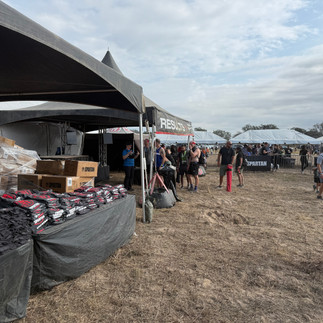
Festival Area . Merch Tent and Staff
I anticipate some major shifts before the next race season. Several sponsors—Reign Energy Drink among them—are stepping away. Spartan is rolling out new T-shirts, medals, and a completely revamped distribution system built around the new Hex design, including generic, non-distance-specific shirts. But the biggest visible change will probably hit the Merch Tent. With Craft no longer serving as the apparel partner, inventory has been thin for months as Spartan clears out whatever’s left. The new apparel partner hasn’t been announced yet, and whatever they bring will simply be different—not necessarily better or worse, just a departure from what we’ve been used to.
I’ve also noticed changes in personnel: longtime DJs, race starters, and even race directors being replaced by new faces. That’s normal in a big organization—nothing inherently good or bad about it—but you can feel the shift. Everything points to this upcoming season being the most different we’ve seen in years.
Overall, the festival area at Sandy Oaks was lively. The Border Patrol were back, along with local military organizations. But the real star of the show was a local BBQ food truck that apparently served transcendent brisket. I wouldn’t know—the line was wrapped around Bag Check after my race, and I don’t have that kind of post-Beast patience. Notably, this was also a no-frills venue: no Cold Wash Station and no Spartan Plus Tent.



Honor Series
This race was not an Honor Series event. When you land at the San Antonio airport, the first thing you see is a giant sign declaring the city “Military Town USA,” and the title is well earned. San Antonio is home to Joint Base San Antonio (JBSA), which combines four major installations: Fort Sam Houston (Army), Lackland Air Force Base (Air Force), Randolph Air Force Base (Air Force), and Camp Bullis (Army). All of this falls under the 502nd Air Base Wing, collectively known as “Military City, USA.”
Earlier in the week, I asked Spartan on the Discord server how Honor Series designations are decided, and the answer was simple and practical. Up until now, the venue has been the deciding factor—venues apply, and Spartan limits how many Honor Series races they approve each season; otherwise, almost every venue would try to claim the label. But next year, Dan McDonald—great guy and Spartan’s head of Operations—will be determining the Honor Series lineup from the outset instead of relying on venue applications. The Honor Series calendar has been announced for 2026, and next year San Antonio will be an Honor Series Race.
Final Thoughts
San Antonio is a solid Trifecta Weekend addition to the race calendar — easy logistics, a fast and mostly flat course, and generally predictable weather. I hope it remains a staple for everyone chasing a Trifecta and looking to race in a part of the country they may not have visited yet.
There’s only one Trifecta Weekend left this season, and many of us will be heading to the infamous Sebring, Florida venue. My Intel Division has informed me that OCR Kings, Rocco Castellano, David Best , the entire M. Watkins entourage will all be on site.
It should be a fun day in the swamp.


Comments