Rock Cycle in So Cal
- Jan 1
- 3 min read
Updated: Feb 7
From Granite to Sediment — The Rock Cycle in Southern California
A Companion to “Process Made Visible Underfoot”
The rock cycle is often visualized as a tidy diagram—igneous rock becomes sedimentary, which becomes metamorphic, which melts and returns to igneous again. But in reality, rock transformations are rarely so clean. Rocks spend the majority of their time not in final forms but in transition—weathering, breaking down, shifting in position, and responding to environmental forces over both short and long timescales.
Understanding this cycle as a set of processes—not fixed stages—helps reveal how material like decomposed granite and sediment behave in real landscapes like those surrounding Perris Lake in Southern California.

From Intrusion to Exposure: How Granite Reaches the Surface
Granite originates deep underground as slow-cooling magma, forming large interlocking crystals of quartz, feldspar, and mica. These minerals give granite its characteristic strength and visual speckling. For millions of years, granite can remain buried, protected from surface conditions by layers of rock and sediment.
However, tectonic uplift eventually brings it closer to the surface, and erosion strips away the overlying material. Once exposed, granite begins to fail—not all at once, but through gradual transformation. This begins with weathering:
Physical weathering cracks the rock via freeze–thaw cycles, temperature changes, and mechanical stress.
Chemical weathering attacks minerals like feldspar, altering them to clay when water and weak acids are present.
The result is decomposed granite (DG)—granite that has broken down in place. It retains its mineral identity but loses its structural cohesion. Angular grains, poor sorting, and a dry, loose texture are typical. From a geological standpoint, DG is neither sediment nor rock—it is material in between, waiting for transport.

The Transformative Role of Transport
Transport is the process that turns decomposed granite into sediment. When water, wind, or gravity moves these grains, new changes occur:
Sorting: Particles are separated by size and density.
Abrasion: Angular grains become rounded.
Mixing: Mineral grains combine with organic material and clays.
Deposition: Finer particles accumulate in low-lying areas, such as basins or lake margins.
Repeated wet-dry cycles, seasonal floods, and even foot traffic can alter sediment structure further. Over long enough periods, and with burial and cementation, sediment may eventually lithify into sedimentary rock—though this step is far from guaranteed.
What’s important to note: most rock-cycle material doesn’t reach a final “rock” state. It remains in transition—eroded, deposited, disturbed, moved again.
Southern California’s Unique Granite Landscape
The geology of Southern California makes this entire cycle unusually visible. The Peninsular Ranges Batholith, which underlies much of the region, formed between 100–90 million years ago as part of an ancient subduction zone. As magma intruded and cooled, it created massive underground granite bodies.
Later, transform faulting along the San Andreas system uplifted the crust. In regions like the San Jacinto Mountains, granite has been fully exposed and stripped of overlying layers—making it one of the most accessible large granite landscapes in the world. The climate is dry, vegetation sparse, and erosion intense. The result: granite everywhere.
This is why decomposed granite is the dominant substrate across the region. It’s not incidental—it’s part of a regional geological narrative: ancient subduction → batholith formation → uplift → exposure → breakdown.
Perris Lake: A Natural Sediment Trap
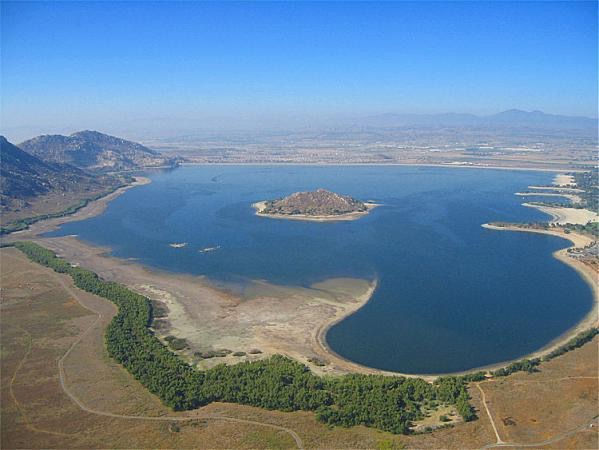
Lake Perris, a man-made reservoir created in the 1970s by damming Perris Creek, now sits in a receiving basin directly downslope from these granitic highlands. The material feeding into the basin is overwhelmingly granite-derived:
Quartz and feldspar dominate the mineral composition.
Fine-grained sediments accumulate near the shoreline after repeated transport cycles.
Seasonal changes in water level expose and rework sediment layers.
Trail use and recreational activity disturb surface deposits, accelerating erosion and dust production.
The lake is, quite literally, collecting the mountain.
Why This Matters
The material at Perris Lake—especially the terrain underfoot on trails and race courses—is not just loose dirt. It is geology in motion. The dust that rises with every footfall, the soft slope failures after rain, the unevenness and instability under dry conditions—these are not maintenance issues. They are expressions of the rock cycle, captured at a particularly legible stage of decomposition and movement.
Understanding where that material sits in the cycle helps explain how it behaves—and why.
Conclusion: A Network, Not a Loop
The rock cycle is best understood not as a closed loop but as a network of processes, each operating on different materials in different contexts. Granite at depth is solid and slow to change. Granite at the surface begins to break. Decomposed granite is fragile, on the brink of motion. Once transported, that material becomes sediment—dynamic, responsive, and shaped by both natural and human forces.
This essay provides the technical context behind the field experience described in Process Made Visible Underfoot, and lays the foundation for the upcoming analysis of field samples collected during the SoCal Trifecta Weekend.


Comments