Part II – The Wolf as Law, Purification, and Moral Violence
- Jan 1, 2025
- 3 min read
Updated: Feb 8

Apollo
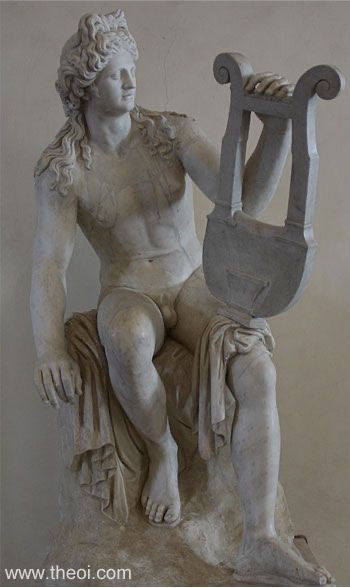
Where other gods embodied appetite, chaos, or excess, Apollo embodied discipline. He was the god of the lyre rather than the drum, of prophecy rather than frenzy, of clean lines rather than ecstatic blur. His power lay not in overwhelming the world, but in structuring it—deciding what belonged, what did not, and what must be removed for balance to return.
Apollo’s violence followed the same logic. When harmony was disrupted, he did not argue. He punished. He sent plagues to cleanse imbalance. He struck with arrows that killed cleanly and from a distance. Apollo does not rage like Ares. He corrects. His cruelty, when it appears, is impersonal and absolute.
He was inseparable from his twin sister, Artemis, who governed the wilderness, the hunt, and the threshold between safety and exposure. Artemis ruled the moment when protection is withdrawn—when a body is tested against fear, solitude, and the unknown. Apollo ruled what followed: the imposition of structure after that exposure. Artemis reveals. Apollo formalizes.
This distinction matters because Apollo was not merely a god worshipped in temples. He was a god invoked by lawgivers. His authority sanctified systems, not experiences. Where Artemis presided over initiation, Apollo presided over institutions.
Only with that foundation does Apollo Lykeios—the wolf-Apollo—come into focus.
If Artemis introduces the wolf as a threshold—as the animal that marks the boundary between protection and exposure—Apollo transforms it into a rule. He takes what was wild and liminal and makes it civic, without ever making it soft.
Where Artemis governs the moment of exposure, when protection is withdrawn and fear is made sacred, Apollo governs what follows: order imposed after the crossing. The wolf, once a liminal animal of initiation at the edges of civilized space, becomes something colder and more exacting under Apollo’s authority. It is no longer merely endured as a test. It is authorized as a tool. It becomes the logic by which the city maintains itself—not through persuasion or consensus, but through the elimination of disorder.
This shift is essential to understanding Sparta.
Without Apollo Lykeios, the Spartan wolf would remain a private ordeal—something faced in the wilderness and left behind upon return. With him, it becomes the logic of law itself. What was once a rite of passage moves into the center: from threshold to assembly, from initiation to operating system.

The wolf rendered as civic symbol rather than wild threat. Here, the animal is no longer a creature of the forest or initiation, but an authorized presence—violence abstracted into law.
Apollo’s harmony is not gentle. It is purifying. When balance fails, he does not convene debate or seek compromise. He sends plagues. He demands silence. He exiles or eliminates whatever element threatens the order. Disorder, in Apollo’s logic, is disease—and disease is not reasoned with.
In his wolf aspect, Apollo fuses the wild with the authoritative in a way that should not work, but does. This is not Artemis’s wolf at the edge of the woods. This is the wolf inside the city—watching, judging, enforcing. The wolf as lawgiver. The wolf as executioner. The wolf as the instrument by which civilization preserves itself through controlled violence.
Artemis exposes.Apollo decides.
Artemis shows you the danger.Apollo determines who survives it.
With Apollo, the wolf becomes righteous violence. Not chaos. Not cruelty. Not rage. Just the calculated removal of imbalance. Violence is not abolished—it is sanctified. It becomes the means by which purity is maintained and disorder is prevented from taking root.
This is where Sparta and Athens diverge.
In Athens, law was persuasion—rhetoric, debate, the clash of arguments in the assembly. In Sparta, law was a blade. Swift. Silent. Final. There were no appeals because there was no uncertainty. The law had spoken, and it was backed by Apollo’s authority.
Apollo’s logic runs deep through Spartan culture. Strength is not nurtured; it is preserved by exclusion. Weakness is not corrected; it is removed. Law does not console; it prunes. Silence is not courtesy—it is control. The laconic style is not minimalism but discipline: speak less so action remains clean. Words are where disagreement multiplies. Action is where order is enforced.
By the time Lycurgus appears—whether historical or mythic—the ground has already been prepared. Without Apollo, he would be a tyrant imposing severity by force. With Apollo, he becomes something else: a lawgiver sanctified by necessity, not inventing Sparta’s harshness but channeling it from sacred authority.
The wolf no longer asks whether you are afraid.It asks whether you belong.


Comments