The Zettelkasten
- Jan 1
- 4 min read
Updated: 4 hours ago
How ideas are kept, connected, and allowed to compound.
A Zettelkasten is the note system that supports the work on this site. It is not a traditional academic Zettelkasten, and it is not a productivity framework. It is operational infrastructure — a way of keeping ideas, field observations, geological references, astronomical data, and cross-domain connections usable across years of work without drift, repetition, or loss. The system runs in Notion. The logic is older than any software. This page explains the role it plays; adjacent pages document how it was built and how it actually operates.
My approach has been influenced by How to Take Smart Notes, which formalizes a method I had already been using in simpler form for years: capturing ideas as small, discrete notes, linking them deliberately, and allowing writing to emerge from their accumulation rather than from inspiration. In academic contexts, this approach is commonly referred to as a Zettelkasten—a note-taking system designed to support long-form thinking and writing through linked, durable notes.
At its core, the system is not complicated.
A Zettelkasten is simply an index-card system — small notes, each capturing a single idea, observation, question, or reference, explicitly linked to related notes so they can be found again later. For many years I did this with physical cards, pens, and highlighters. What’s changed is the medium, not the logic.
Today, those “cards” often live in a distributed computer environment rather than a physical box. Digital tools make the work easier to search, rearrange, and scale, but they did not invent the method. They recreate — imperfectly but conveniently — something that has always been fundamentally analog.
For readers interested in how this translation works in practice, I document one concrete implementation in How the Zettelkasten Was Built in Notion, focusing on structure and workflow rather than software features.
The purpose remains the same: to keep ideas from disappearing once the initial interest passes — and to make them usable when they matter.
What the Zettelkasten actually is
In practical terms, it’s a growing collection of short, durable notes:
one idea, observation, or reference per note
written to be understandable on their own
explicitly linked to other relevant notes
Some notes capture understanding. Others capture context. Others exist purely as reference — definitions, background material, boundary conditions, or domain knowledge that constrains interpretation. Not every note represents mastery, and it doesn’t need to.
Over time, the links between notes make patterns visible that wouldn’t appear in isolated documents or drafts. Writing happens when enough related notes form a coherent shape.
This is not productivity theater, and it isn’t a system to copy wholesale. It’s a way of working that supports long-horizon, field-based work without relying on memory, inspiration, or the illusion of complete understanding in advance.
How this system is used
This Zettelkasten is designed to be operated, not studied.
Like software documentation, release notes, or an owner’s manual, many notes are meant to be consulted when needed rather than read sequentially or internalized all at once. Understanding develops through use. Reference material exists to stabilize meaning, prevent drift, and ground writing in reality.
Reading, field work, and research feed the system continuously. Writing draws from it when patterns emerge. Learning does not stop the work; it happens alongside it.
What the Zettelkasten does:
Keeps reading notes, field observations, references, and research fragments usable
Allows ideas from different domains to connect naturally
Reduces the need to “remember everything”
Provides reference points that constrain speculation
Makes writing a result of accumulation, not effort
Notes do not start as essays or arguments. They start as records: something noticed, something learned, something checked, something that didn’t quite fit.
Some notes fade into the background. Others become load-bearing as new material connects to them. Writing emerges from that process rather than being forced.
A note on terminology
Despite the German name, there’s nothing exotic about this.
For decades, this work was done with index cards, pens, and highlighters — a small box on a desk, cross-references scribbled in the margins, ideas grouped and regrouped by hand. The total cost was whatever a pack of cards and basic office supplies happened to be.
What computers changed wasn’t the method. They removed friction.
The logic is old:
capture one thing at a time
keep notes small and readable
link related material
return to it later
Software didn’t invent that. It just made it easier to operate at scale.
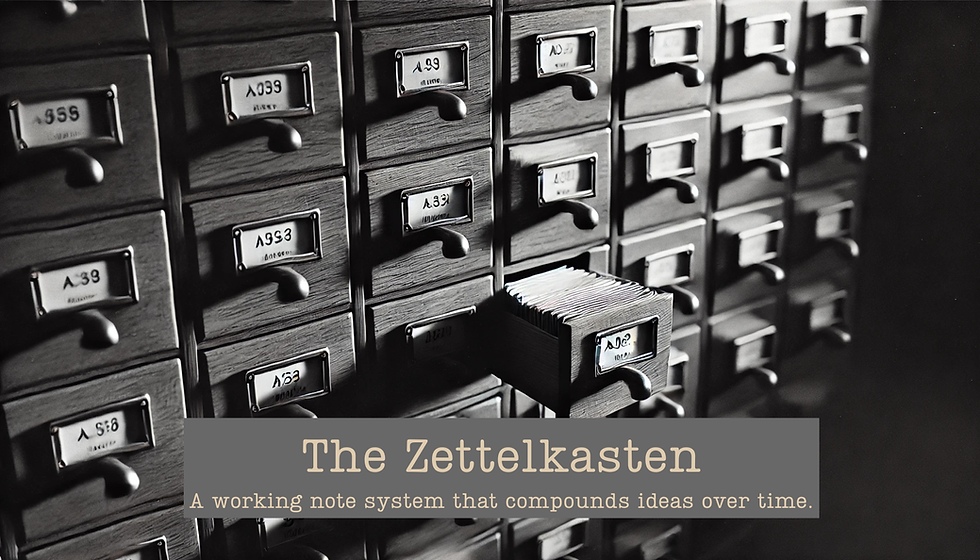
That’s also why the imagery around this section is deliberately analog. The point isn’t nostalgia — it’s a reminder that the thinking comes first. Tools come later.
What it is not
Not a second-brain fantasy
Not a productivity hack
Not a system that guarantees output
Not a substitute for thinking or experience
The value isn’t speed. It’s durability.
Ideas can sit dormant for months or years and still be retrievable when they matter again.
How it fits with the rest of the site
The Zettelkasten sits between gathering material and writing.
Reading, research, and field work feed the note system. Writing draws from it. The notes themselves aren’t meant to be impressive — they’re meant to be reliable.
The practical mechanics — how notes are created, maintained, linked, and turned into finished work — are documented elsewhere on the site:
a page explaining how the Zettelkasten is built and maintained
a walkthrough of the Notion environment used to catalog and connect material
examples showing how notes turn into outlines and published work
Those pages exist to make the system concrete, not theoretical.
This page explains the role the Zettelkasten plays in the larger process. If you’re interested
in the mechanics, you can follow those links. If you’re not, you don’t need to think about it at all — the site works either way.


Comments